Bible words · King James Version
Biblical Meaning of Selah

Selah is a Hebrew word found 74 times in the Bible: 71 times in the Psalms and three times in the prayer of Habakkuk. Its exact meaning is not known. It is most likely a musical or liturgical mark, and Strong’s Concordance understands it as a pause. Selah is not a word to be translated so much as an instruction to be obeyed: stop here, and weigh what has just been said.
10 Be still, and know that I am God: I will be exalted among the heathen, I will be exalted in the earth.11 The LORD of hosts is with us; the God of Jacob is our refuge. Selah.
Selah in Hebrew
Hebrew · Old Testament
סֶלָה
çelâh (seh'-law) · Strong’s H5542
- Strong’s definition
- suspension (of music), i.e. pause
- Translated in the King James Version as
- Selah
Hebrew and Greek words, definitions and King James renderings from James Strong’s Exhaustive Concordance of the Bible (1890), which is in the public domain.
In the King James Bible, “selah” appears 74 times in 74 verses, all in the Old Testament. The first is Psalm 3:2, and the book with the most is Psalms (71).
Where Selah Appears
Selah is one of the most familiar and least understood words in the Bible. It appears 71 times in the Psalms, spread across 39 psalms, and three more times in the third chapter of Habakkuk, a prayer the prophet wrote to be sung. It never appears in the New Testament, and outside the Psalms and Habakkuk it does not appear as this word at all. (The King James Bible also names a city Selah in 2 Kings 14:7, a different word for a place in Edom.)
The first Selah comes early, in David’s psalm written when he fled from his son Absalom:
Many there be which say of my soul, There is no help for him in God. Selah.
Notice where it stands: right after the words of his enemies. They said God would not help him. Selah. Then David answers: “But thou, O LORD, art a shield for me” (Psalm 3:3). The pause sits between the accusation and the reply.
What the Word Means, and What Is Not Known
The honest answer is that no one knows for certain what Selah meant when the Psalms were first sung. The Bible never defines it. Translators, including the King James translators, have left it untranslated, carrying the Hebrew word straight into English.
Strong’s Concordance gives the word as çelâh and defines it as “suspension (of music), i.e. pause.” It connects the word to a verb Strong’s defines as “to hang up, i.e. weigh.” Others have suggested different meanings, such as a sign for singers or instruments to lift up. Scripture itself does not settle the question.
What we can see is how it is used. Of the 39 psalms that contain Selah, 28 carry a heading addressed to the chief Musician, the director of the temple’s music. Habakkuk’s prayer, the only place outside the Psalms where Selah appears, ends with a note to that same director: “To the chief singer on my stringed instruments” (Habakkuk 3:19). Selah belongs to songs meant for worship. It is a mark in the music, and its natural sense is a break: stop, rest, let the words sink in.
Selah After Hard Truth
Some Selahs come after painful words. In Psalm 32, David describes the misery of hiding his sin, and then the relief of confessing it:
I acknowledged my sin unto thee, and mine iniquity have I not hid. I said, I will confess my transgressions unto the LORD; and thou forgavest the iniquity of my sin. Selah.
Selah. After forgiveness, a pause. There is no rush to move on. The reader is invited to stand still in the fact that God forgave, and to feel the weight lifted.
Psalm 4 does the same with a different kind of hard word. David tells his hearers to “Stand in awe, and sin not: commune with your own heart upon your bed, and be still” (Psalm 4:4), and then writes Selah. (Read that psalm verse by verse in Psalm 4:8 KJV.) The pause is part of the counsel. Be still, and stop talking.
Selah After Great Truth
Other Selahs come after the greatest words in the Psalms. Psalm 46 uses Selah three times, and the last time it closes the psalm:
1 God is our refuge and strength, a very present help in trouble.2 Therefore will not we fear, though the earth be removed, and though the mountains be carried into the midst of the sea;3 Though the waters thereof roar and be troubled, though the mountains shake with the swelling thereof. Selah.
The earth shaking and the sea roaring, and then: Selah. Stop and take that in. God is our refuge even then. The psalm ends with God’s own voice, quoted at the top of this page, telling His people to be still and know that He is God, and one last Selah.
Only four psalms end with Selah, and Psalm 46 is one of them. The last word of the psalm is not a word at all, but silence before God.
Psalm 89 has more Selahs than any other psalm, four in all. It is a song about God’s covenant with David, and the first Selah comes straight after God’s oath:
3 I have made a covenant with my chosen, I have sworn unto David my servant,4 Thy seed will I establish for ever, and build up thy throne to all generations. Selah.
A promise that a throne will stand to all generations deserves a pause. So does an invitation like this one: “Trust in him at all times; ye people, pour out your heart before him: God is a refuge for us. Selah” (Psalm 62:8) Before the next line, the reader is given room to do exactly that.
Habakkuk uses Selah the same way, after a vision of God’s majesty: “God came from Teman, and the Holy One from mount Paran. Selah” (Habakkuk 3:3) Then the description goes on: His glory covered the heavens.
How to Read Selah Today
When you read the Psalms aloud, you may be tempted to say “Selah” and keep going, or to skip it. Try obeying it instead.
- Stop. Do not read the next verse yet.
- Weigh what was just said. Whatever the word first meant in the music, a pause after Scripture is time to let it carry its full weight: a promise, a warning, a confession, a praise.
- Answer God. Many Selahs follow a truth that calls for a response. Thank Him, confess, trust, or simply be quiet before Him.
In a world that rarely stops, Selah is a gift. God built pauses into His people’s songs. Worship is not only words; it is also attention.
A Prayer to Pause Before You
Father, I fill my days with noise and rush past your words without letting them land. Thank you for the pauses you placed in the Psalms, and for the invitation to be still and know that you are God. Teach me to stop when you speak, to weigh your word, and to answer you, in confession and in praise. When the earth seems to shake, let me rest in you, my refuge and strength. Through Jesus Christ our Lord, Amen.
This prayer is an example to help you find words. Speak to your Father from your heart, in your own words, through His Son, in Jesus’ name, as Jesus taught (John 16:23).
Share This Verse
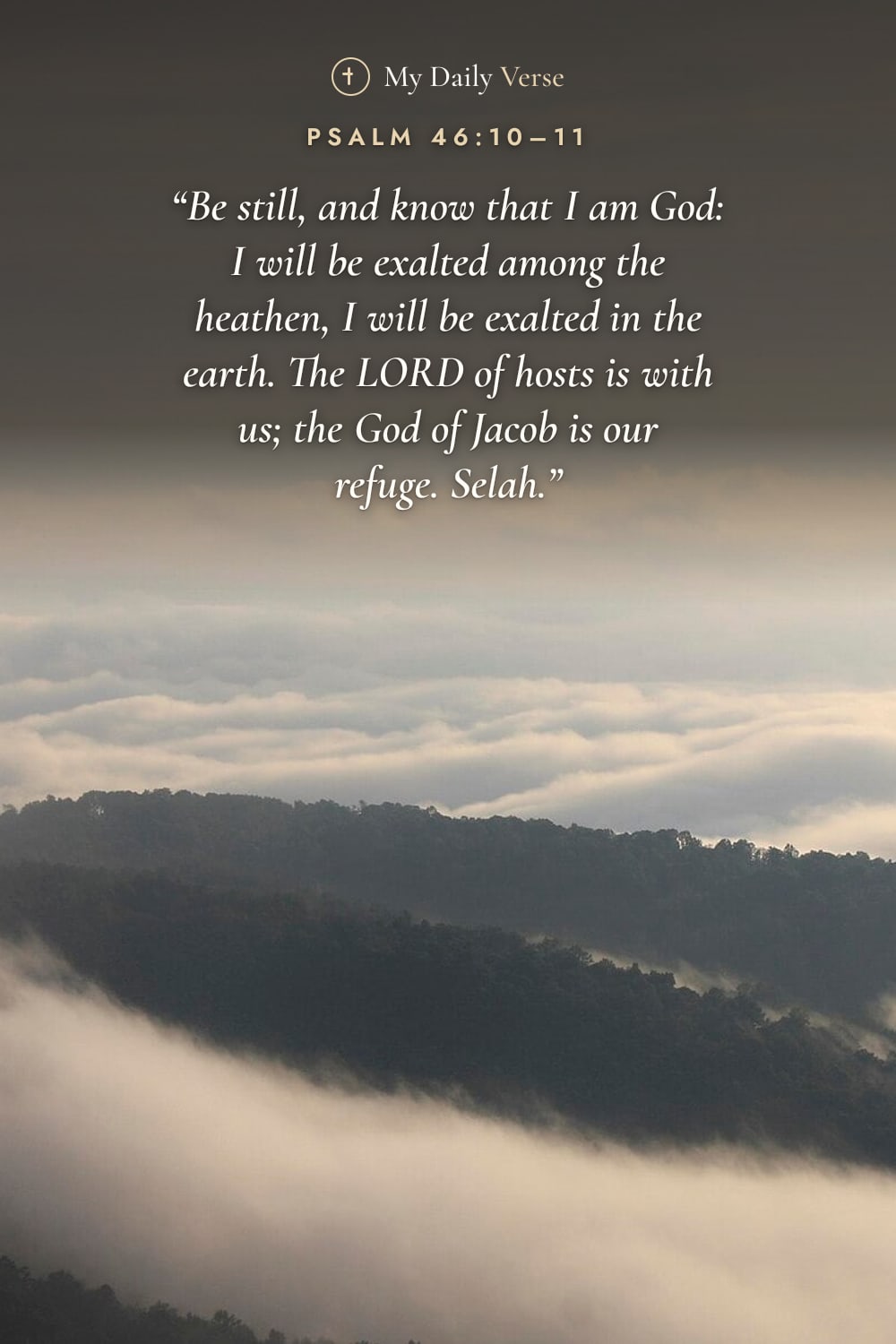
A picture of Psalm 46:10–11 with the meaning of selah, for Pinterest, Facebook or your phone.
