Bible words · King James Version
Biblical Meaning of Grace

In the Bible, grace is God’s favor and kindness given to people who have not earned it and could never repay it. In the Old Testament it is the favor Noah and Moses “found” in the LORD’s sight. In the New Testament it is God’s undeserved love given in Jesus Christ: by grace sinners are saved through faith, and by grace they are then strengthened to live for Him.
For by grace are ye saved through faith; and that not of yourselves: it is the gift of God:
Grace in Hebrew and Greek
Hebrew · Old Testament
חֵן
chên (khane) · Strong’s H2580
- Strong’s definition
- graciousness, i.e. subjective (kindness, favor) or objective (beauty)
- Translated in the King James Version as
- favour, grace(-ious), pleasant, precious, (well-) favoured
Greek · New Testament
χάρις
cháris (khar'-ece) · Strong’s G5485
- Strong’s definition
- graciousness (as gratifying), of manner or act (abstract or concrete; literal, figurative or spiritual; especially the divine influence upon the heart, and its reflection in the life; including gratitude)
- Translated in the King James Version as
- acceptable, benefit, favour, gift, grace(- ious), joy, liberality, pleasure, thank(-s, -worthy)
Hebrew and Greek words, definitions and King James renderings from James Strong’s Exhaustive Concordance of the Bible (1890), which is in the public domain.
In the King James Bible, “grace”, “gracious” and “graciously” appear 205 times in 193 verses: 72 in the Old Testament and 133 in the New. The first is Genesis 6:8, and the book with the most is Romans (24).
Grace Begins with Noah
The first time the word appears in the King James Bible, the world is about to be judged. Wickedness has filled the earth, and the LORD has said He will destroy it. Then one sentence changes the story:
But Noah found grace in the eyes of the LORD.
The Hebrew word is chên. Strong’s defines it as “graciousness,” and lists the ways the King James translators rendered it: favour, grace, gracious, pleasant, precious. The word comes from the verb chânan, which Strong’s explains as “to bend or stoop in kindness to an inferior.” That is the picture at the heart of grace. It is not two equals trading favors. It is the greater bending down to the lesser.
Notice the verb, too. Noah found grace. He did not earn it, buy it or demand it. The same language runs through the Old Testament: Joseph found grace in his master’s sight, Ruth found grace in the eyes of Boaz, and Esther obtained grace and favour before the king. Each time, someone with the power to refuse chose to show favor instead.
The fullest example is Moses. After Israel’s sin with the golden calf, he pleads with God not to abandon the people, and God answers him in words of astonishing kindness: “thou hast found grace in my sight, and I know thee by name” (Exodus 33:17). Grace in the Old Testament is personal. God knows the one He favors.
Grace and Truth Came by Jesus Christ
In the New Testament the word is cháris. Strong’s gives a long definition: “graciousness (as gratifying), of manner or act … especially the divine influence upon the heart, and its reflection in the life.” Both halves of that definition matter. Grace is God’s favor toward us, and it is also His work in us that shows in how we live.
John opens his Gospel by saying the Word became flesh, “full of grace and truth” (John 1:14). Then he adds:
16 And of his fulness have all we received, and grace for grace. 17 For the law was given by Moses, but grace and truth came by Jesus Christ.
“Grace for grace” means one gift upon another, wave after wave from the same fullness. John is not saying the law was bad; it was God’s gift through Moses. He is saying that what the law pointed toward has arrived in a Person. Grace is not first an idea or a doctrine. It is Jesus Christ, giving Himself.
Saved by Grace, Not by Works
Paul uses cháris more than any other New Testament writer, and Romans holds the word “grace” more often than any other book of the King James Bible, 24 times. His central claim is simple: no one is made right with God by earning it.
23 For all have sinned, and come short of the glory of God; 24 Being justified freely by his grace through the redemption that is in Christ Jesus:
“Freely” is the key word. Justification is a gift. Ephesians says the same thing in the verse quoted at the top of this page, and goes on: “Not of works, lest any man should boast” (Ephesians 2:9). Paul even argues that grace and earning cannot be mixed. If salvation were partly earned, “otherwise grace is no more grace” (Romans 11:6).
This is the hardest part of grace for proud people to accept, and the sweetest part for broken people to hear. You cannot add to it. You can only receive it.
Grace Is Not Permission to Sin
Paul knew his teaching could be twisted. If “where sin abounded, grace did much more abound” (Romans 5:20), someone might reason that more sin would mean more grace. His answer is immediate: “God forbid. How shall we, that are dead to sin, live any longer therein” (Romans 6:2)
The grace that forgives also trains. Paul wrote to Titus:
11 For the grace of God that bringeth salvation hath appeared to all men, 12 Teaching us that, denying ungodliness and worldly lusts, we should live soberly, righteously, and godly, in this present world;
Grace is a teacher. The same favor that saves a sinner begins to change what that sinner loves. That is the second half of Strong’s definition at work: grace received in the heart, reflected in the life. A person who says they live under grace but has no wish to leave their sin has misunderstood the word.
Grace for Weakness and for Every Day
Grace is not only for the day a person first believes. Paul begged the Lord three times to take away a painful trial he called a thorn in the flesh. The answer was not removal but supply:
And he said unto me, My grace is sufficient for thee: for my strength is made perfect in weakness. Most gladly therefore will I rather glory in my infirmities, that the power of Christ may rest upon me.
Here grace is strength given in the moment it is needed, and it shows most clearly where human strength runs out. Hebrews invites believers to come for it often:
Let us therefore come boldly unto the throne of grace, that we may obtain mercy, and find grace to help in time of need.
“Mercy” and “grace” sit side by side in that verse, and the difference between them is worth knowing. Mercy holds back what we deserve; grace gives what we do not deserve. At the throne of grace a believer finds both: pardon for yesterday and help for today.
Scripture also says who receives the most of it: “God resisteth the proud, but giveth grace unto the humble” (James 4:6). And it says grace is something to grow in, not only to begin with: “But grow in grace, and in the knowledge of our Lord and Saviour Jesus Christ” (2 Peter 3:18).
Grace Received Becomes Thanks Given
Strong’s list of renderings for cháris holds a surprise: the King James translators sometimes rendered it “thanks.” In Greek, the favor God gives and the gratitude that answers it are the same word. Grace naturally flows back to God as thanksgiving.
Paul felt this about his own life. He had persecuted the church, and he never got over the kindness that saved him: “But by the grace of God I am what I am” (1 Corinthians 15:10). Grace did not make him lazy. He worked harder than anyone, and then gave the credit away: “yet not I, but the grace of God which was with me” (1 Corinthians 15:10).
That is what grace looks like in a life. It begins with God bending down, it is given in Jesus Christ, it saves without our help, it teaches us to live differently, it holds us up when we are weak, and it turns into thanks.
A Prayer for Grace
Father, I have nothing to bring you that would earn your favor, and you have never asked me to. Thank you for the grace that found Noah, that knew Moses by name, and that came to us full and free in your Son. Let me receive it humbly, not as permission to sin but as the power to leave sin behind. When I am weak, let your grace be enough for me. Teach me to grow in it day by day, and to answer it with thanks. In the name of Jesus Christ, Amen.
This prayer is an example to help you find words. Speak to your Father from your heart, in your own words, through His Son, in Jesus’ name, as Jesus taught (John 16:23).
Share This Verse
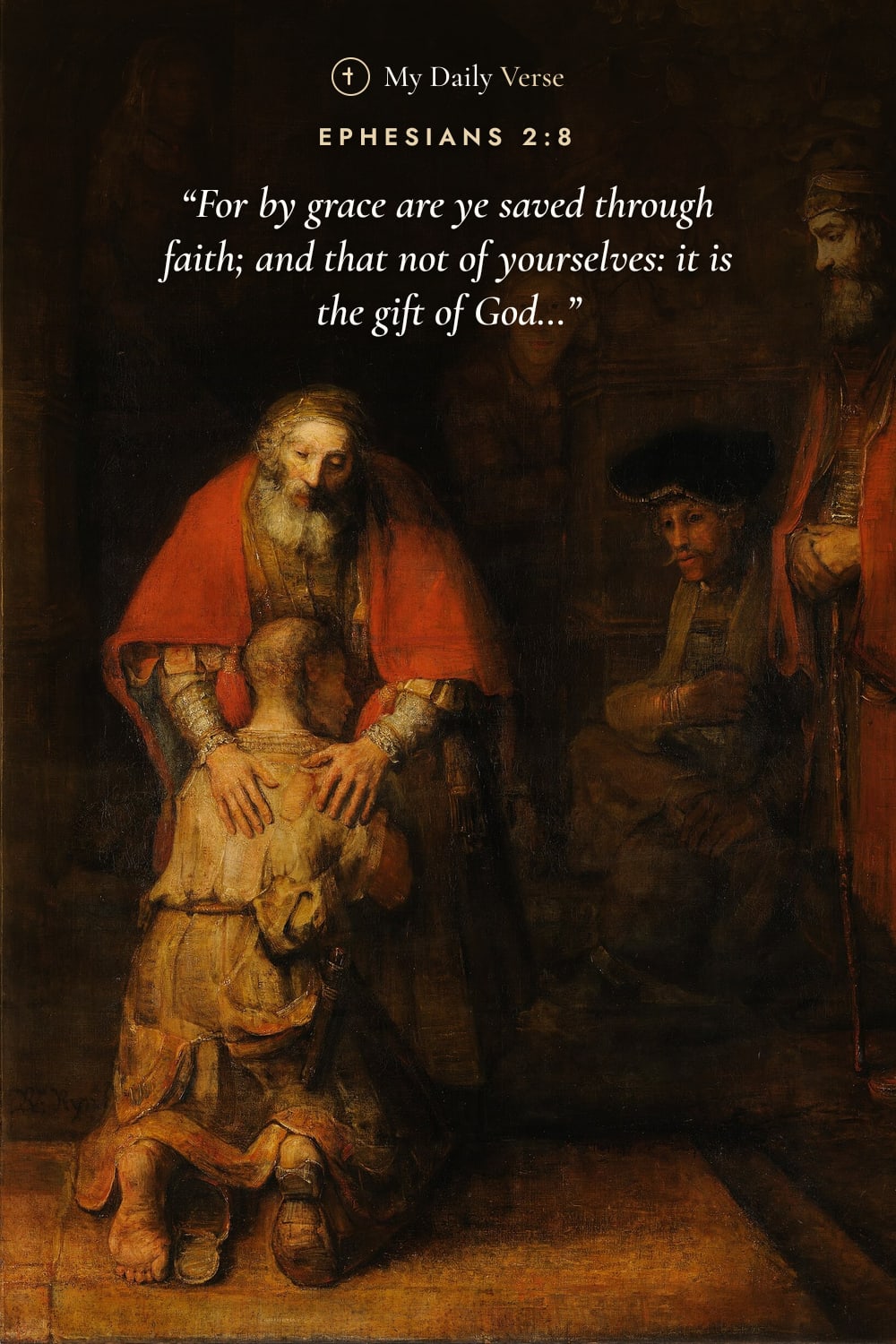
A picture of Ephesians 2:8 with the meaning of grace, for Pinterest, Facebook or your phone.
