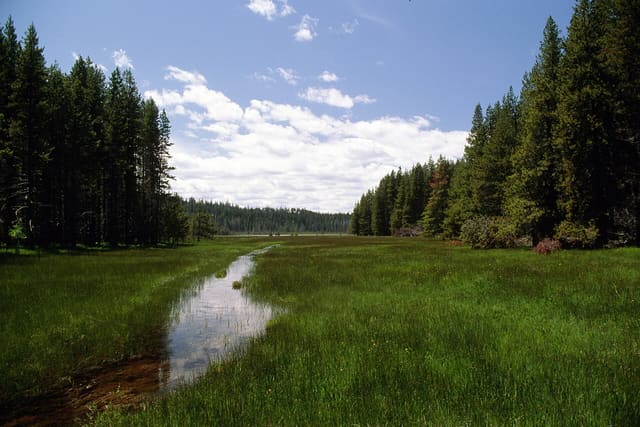
Some people cannot stop. The phone gets checked one last time at midnight, the to-do list follows them to bed, and a day off feels like falling behind. Others would love to rest and simply cannot: the mind keeps running long after the body has stopped. Psalm 23:2 speaks to both, and its first verb is a surprise. The shepherd does not merely allow his sheep to rest. “He maketh me to lie down”.
What it meant then
Green grass was not something a shepherd in Israel could take for granted. The rains come in the cooler months. Through the long dry summer the hills turn brown, and a shepherd had to know where pasture could still be found and lead the flock to it. “green pastures” meant a shepherd who had gone ahead and done the searching.
Then there is the order of the line. Sheep graze, and afterward they lie down to rest and chew the cud. A sheep lying down in green pasture has eaten its fill and has nothing to run from. The picture is of a flock fed, safe and still.
The second line adds water: “he leadeth me beside the still waters”. The Hebrew phrase is usually rendered waters of rest, and many modern translations give it as quiet waters. This is water a flock can reach and drink in peace, away from the rush of a ravine in flood. And the shepherd leads. He walked in front, and the sheep followed his voice (John 10:4).
What it means today
Rest, in this verse, is something the Shepherd gives. That is good news for the person who will not stop and for the person who cannot settle.
For the one who will not stop, the word maketh is a gentle correction. There are seasons when God slows us down, and the slowing feels like loss. Yet the Shepherd who makes his sheep lie down is not wasting their time. He knows how far the flock still has to go. When Elijah collapsed in the wilderness, worn out and ready to give up, God’s first answer was food and sleep, twice, before a single question was asked (1 Kings 19:5-9).
For the one who cannot settle, look at what made the sheep able to lie down: they had been fed, and the shepherd was near. Rest grows out of trust. It does not come from trying harder to relax. It comes from remembering who is keeping watch.
Mark’s Gospel has a quiet echo of this verse. Jesus looks at a tired crowd and sees them “as sheep not having a shepherd” (Mark 6:34). He teaches them, then has them sit down “upon the green grass” (Mark 6:39) and feeds every one of them. Just before, he had told his weary disciples to come away with him and “rest a while” (Mark 6:31). The Shepherd of Psalm 23 still makes his people lie down, and he still feeds them first.
Carry it today
Choose one stretch of time today, even fifteen minutes, and stop on purpose. Put the phone in another room. Sit, or lie down if you can, and read Psalm 23:2 once, slowly. Then name to God the thing that usually keeps you from resting, and leave it with the one who keeps watch while his sheep sleep (Psalm 121:4).
Prayer
Lord, my shepherd, you know how restless I am. You know the lists I carry to bed and the worries that wake me before dawn. Thank you that rest is your gift and not my achievement. Lead me today to the green grass and quiet water you have already found. When you slow me down, help me trust that you know the road ahead. Feed me, keep watch over me, and let me lie down in peace. In the name of Jesus Christ, Amen.
This prayer is an example to help you find words. Speak to your Father from your heart, in your own words, through His Son, in Jesus’ name, as Jesus taught (John 16:23).
Read all of Psalm 23 in the King James Version, verse by verse: Psalm 23 KJV: The Lord Is My Shepherd