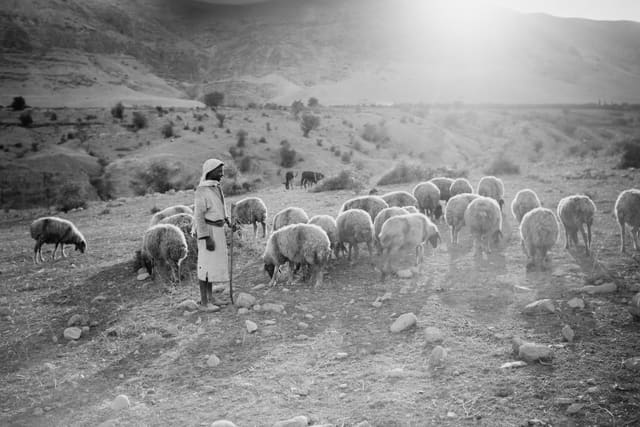
Psalm 23 has its place beside hospital beds and at gravesides, but it was not written only for the end of life. It was written for the middle of it: the month the bills outrun the paycheck, the evening a diagnosis rearranges the calendar, the season when the house is too quiet. The psalm opens with nine words in the King James Version. Everything that follows, the green pastures and still waters, the dark valley, the table and the house of the LORD, grows out of this first sentence about who God is and whose we are.
What it meant then
The psalm’s heading names David as its writer, and few people in Israel knew sheep better. He was the youngest son, the one left out in the fields when the prophet Samuel came to Jesse’s house (1 Samuel 16:11). He later told King Saul how he had gone after a lion and a bear to rescue a lamb from the flock (1 Samuel 17:34-35). God took him “from the sheepfolds” (Psalm 78:70) to lead a nation.
That makes the first line remarkable. In the ancient Near East, kings liked to call themselves the shepherds of their people; the Babylonian king Hammurabi did so in the prologue to his laws. David, the shepherd who became a king, does not claim the title for himself. He gives it away: “The LORD is my shepherd”.
LORD in capital letters stands for God’s own name, the name he made known to Moses at the burning bush (Exodus 3:15). David is not speaking of a distant power. He is speaking of the God who binds himself to his people by promise, and he calls that God “my shepherd”.
What it means today
“I shall not want” is the conclusion David draws. In the King James Version, want means lack. The sheep of this shepherd will not go without what it needs. Moses said the same of Israel’s forty years in the wilderness: “thou hast lacked nothing” (Deuteronomy 2:7). Those years held little luxury. There was manna each morning, water from the rock, and clothes that did not wear out (Nehemiah 9:15-21). But nothing they needed was missing.
That matters for an honest reading. The verse does not promise everything you would like to have. A sheep does not choose its own pasture. What the verse promises is a shepherd who knows what you need and will not neglect it. Jesus said the same: your heavenly Father knows you need these things (Matthew 6:32). Paul, who knew both hunger and plenty, learned to be content in either (Philippians 4:11-12).
Notice the order of the sentence, too. The second half rests entirely on the first. David does not say he lacks nothing because his circumstances are good. He lacks nothing because of who his shepherd is. Circumstances change. The shepherd does not.
For Christians the shepherd has a face. Jesus called himself the good shepherd (John 10:11), and the psalm, read verse by verse, leads straight to him.
So when you look today at what is missing, the money, the health, the person, the verse does not ask you to pretend it is there. It asks you to look first at whose you are.
Carry it today
Write Psalm 23:1 on a card and keep it where you will see it. Underneath, write the one thing you are most afraid of lacking this week. Each time the card catches your eye, read the verse first and the worry second, in that order, so the shepherd always comes before the need.
Prayer
Lord, you are my shepherd, and I belong to you. You know what I need better than I do, and you know what I am afraid of losing. Teach me the difference between what I want and what I truly lack. Where I am anxious about tomorrow, remind me whose I am. Give me what I need for today, and the contentment to rest in it. In the name of Jesus Christ, the good shepherd, Amen.
This prayer is an example to help you find words. Speak to your Father from your heart, in your own words, through His Son, in Jesus’ name, as Jesus taught (John 16:23).
Read all of Psalm 23 in the King James Version, verse by verse: Psalm 23 KJV: The Lord Is My Shepherd