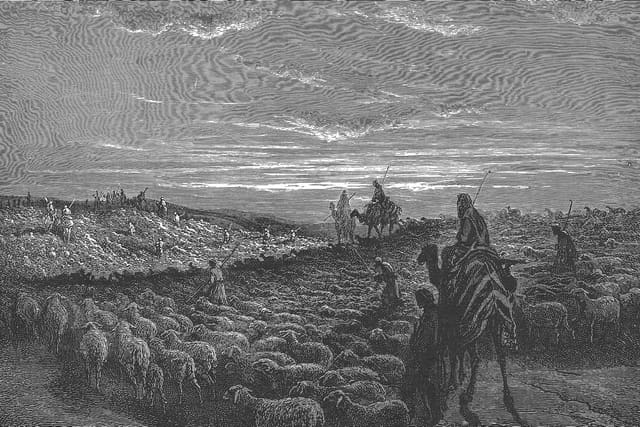
Faith is often pictured as a leap in the dark. Hebrews 11:1 describes something steadier than that. It was written for people whose courage was wearing thin, and it tells them that faith stands on ground that is already there, even when they cannot yet see it. Perhaps you are sitting beside someone who is dying, or seven months into looking for work, and holding on to a promise of God with tired hands. This verse was not first written for scholars at a desk. It was written for people in exactly that place.
What it meant then
The letter to the Hebrews was sent to believers who had once suffered bravely. The writer reminds them that they had “endured a great fight of afflictions” (Hebrews 10:32): public insults, standing by those in chains, their goods taken from them (Hebrews 10:33-34). Now some were growing weary and were tempted to draw back. So the writer pleads, “Cast not away therefore your confidence” (Hebrews 10:35), reminds them that “the just shall live by faith” (Hebrews 10:38), and adds, “we are not of them who draw back” (Hebrews 10:39).
The chapter numbers were added long after the letter was written, and the thought runs straight on. Verse 1 begins with “Now”: having said that the just live by faith, the writer shows what that faith looks like. What follows is less a definition than a portrait gallery: Abel, Noah, Abraham, Sara, Moses and many more. The writer is honest about them. “These all died in faith, not having received the promises” (Hebrews 11:13). They saw those promises “afar off”, and they held on to them anyway.
What it means today
Take the verse a phrase at a time. Faith is “the substance of things hoped for”. The Greek word behind substance is hypostasis. It can mean the solid reality that stands underneath a thing, or the firm assurance of a person who rests on it; lexicons and English translations differ on which sense is meant here. Earlier in the letter the King James translates the same word “confidence” (Hebrews 3:14), in a call to hold that confidence steady to the end. Either way, faith does not make God’s promise real; it rests on a promise that is already real because God made it.
Then faith is “the evidence of things not seen”. Evidence here means proof that convinces, a settled conviction that something is so. You have not yet seen the resurrection morning, or the city Abraham looked for, or the end of your grief. Faith is being convinced of them anyway, because of who promised. Sara, the chapter says, “judged him faithful who had promised” (Hebrews 11:11). Her faith rested less on the child she hoped for than on the One who had given his word.
So faith can be real when feelings are low. Many in Hebrews 11 died waiting. Faith did not spare them hardship. It kept them walking toward God through it.
Then the writer turns from the list to one person: “Looking unto Jesus the author and finisher of our faith” (Hebrews 12:2). He ran the whole race of faith ahead of us, and ran it to the end. He endured the cross, and he now sits at God’s right hand.
Carry it today
Choose one promise of God you are still waiting to see in full: his word that he will never leave you (Hebrews 13:5), perhaps, or that he will wipe away all tears (Revelation 21:4). Say it aloud this morning, and then add the words from this same letter, “he is faithful that promised” (Hebrews 10:23). When doubt comes today, say both again, and let the second answer it.
Prayer
Lord, I cannot yet see everything you have promised, and some days I am tired of waiting. Thank you for the men and women who died in faith and never let go. Make my faith like theirs: not a feeling I have to stir up, but a steady confidence in you. When I am tempted to draw back, turn my eyes to Jesus, who ran the race of faith before me and finished it. You are faithful who promised. In the name of Jesus Christ, the author and finisher of our faith, Amen.
This prayer is an example to help you find words. Speak to your Father from your heart, in your own words, through His Son, in Jesus’ name, as Jesus taught (John 16:23).