December is called the season of joy, and the songs in every shop say so. Yet many people come to Christmas tired, grieving or simply flat, and the cheerful music only makes the distance feel wider. The Bible speaks about joy in a different way. It treats joy as something God gives, strong enough to hold a person up on a hard day. Nowhere is that plainer than in the verse on the card above: “the joy of the LORD is your strength”.
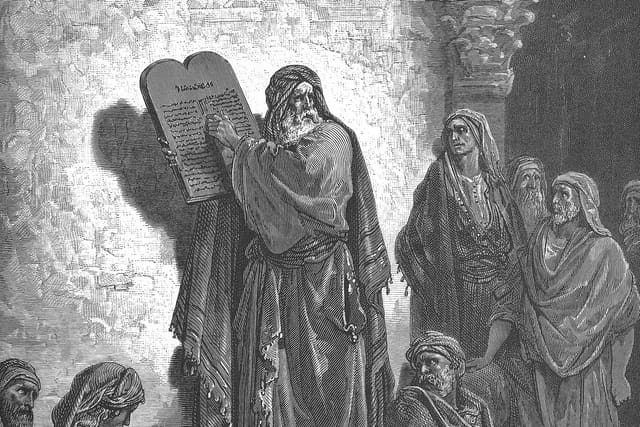
Those words were first spoken to a crowd in tears. Jerusalem’s wall had just been rebuilt after long years in ruins, and the people gathered in the open square while Ezra the scribe read the book of the law aloud “from the morning until midday” (Nehemiah 8:3). As they understood it, they wept, because they could hear how far they had fallen short.
Their leaders stopped them. This was a holy day, a day for feasting, and the people were sent home to eat, drink and share with anyone who had nothing. Eat the fat means eat rich food; be ye sorry means grieve. The reason given was the verse itself: their strength would come from the LORD’s joy, not from their own record.
By evening the city had gone home “to make great mirth, because they had understood the words that were declared unto them” (Nehemiah 8:12). Joy came through understanding God’s word, not in spite of it.
The same joy is the note of Christmas. The angel’s first words to the shepherds were “good tidings of great joy, which shall be to all people” (Luke 2:10), and the best-loved carol of the season, Isaac Watts’s “Joy to the World”, is his paraphrase of Psalm 98, a psalm that calls all the earth to make a joyful noise. Below are five more King James passages on joy, each with its setting and a word for today, then ways to use them and a prayer.
Make a Joyful Noise unto the LORD
1 Make a joyful noise unto the LORD, all ye lands.2 Serve the LORD with gladness: come before his presence with singing.
Psalm 100 is headed A Psalm of praise. Worshippers sang it as they came up to the temple, and it calls on “all ye lands”, every nation on earth, to join them. The reason comes in the verses that follow: the LORD made us, we are his people and the sheep of his pasture, and “his mercy is everlasting” (Psalm 100:5).
A joyful noise does not have to be a beautiful one. The psalm asks for gladness and singing, not talent. If yours is the voice you keep quiet in church, this verse invites you to sing anyway, in the car or at the kitchen sink. Joy is often found by doing what the psalm says before the feeling arrives, serving the LORD with gladness and coming into his presence with thanks.
Rejoice in the Lord Alway
Rejoice in the Lord alway: and again I say, Rejoice.
Paul wrote these words from prison, where his chains had become known “in all the palace” (Philippians 1:13). The church at Philippi understood what that meant. It had begun years before, when Paul and Silas, beaten and fastened in the stocks, prayed and sang praises to God at midnight (Acts 16:25). Alway means at all times. Paul says the command twice, as if he expects his readers to answer that it cannot be done.
The weight of the verse rests on two small words: in the Lord. Circumstances change, and the Lord does not. Paul is not asking anyone to pretend that prison is pleasant, or that this December is easy. He points to the one thing that stays true in every season and invites the reader to be glad of him. A few verses later he gives the next step, to bring every care to God in prayer (Philippians 4:6-7).
Count It All Joy
2 My brethren, count it all joy when ye fall into divers temptations; 3 Knowing this, that the trying of your faith worketh patience. 4 But let patience have her perfect work, that ye may be perfect and entire, wanting nothing.
James wrote to believers “scattered abroad” (James 1:1), far from home and under pressure. Divers temptations means trials of many kinds, and wanting nothing means lacking nothing. James does not call the trials themselves joy. He tells his readers to count them as joy because of what God does through them: faith that is tested learns patience, and patience, given time, makes a person whole.
This is among the hardest verses in the Bible to obey, and it is best read slowly. To count is to decide how to see something, and the decision is made while the feelings are still sore. If you are in the middle of a long trial, James does not ask you to smile about it. He asks you to trust that it is not wasted, that the God who allowed it is using it, and to let patience “have her perfect work”.
A Merry Heart Doeth Good Like a Medicine
A merry heart doeth good like a medicine: but a broken spirit drieth the bones.
This proverb stands in the long collection headed “The proverbs of Solomon” (Proverbs 10:1). It sets two hearts side by side. A merry heart works like medicine, while a broken spirit “drieth the bones”, draining a person’s strength from the inside.
Laughter is a gift from God, and the Bible is not embarrassed by it. When Isaac was born, Sarah said that God had made her laugh, and that everyone who heard would laugh with her (Genesis 21:6). If your home has gone quiet this year, a merry heart can be practiced: an evening of old family stories, a funny film together, an hour with the friend who always makes you laugh. It will not fix everything, but the proverb says it does good, and it does.
Yet I Will Rejoice in the LORD
17 Although the fig tree shall not blossom, neither shall fruit be in the vines; the labour of the olive shall fail, and the fields shall yield no meat; the flock shall be cut off from the fold, and there shall be no herd in the stalls: 18 Yet I will rejoice in the LORD, I will joy in the God of my salvation.
Habakkuk was a prophet in Judah who saw the armies of Babylon coming, and he complained to God about it before he learned to trust him (Habakkuk 1:2-6). His book ends with a prayer. In these verses he pictures every crop failing, the fig tree, the vine and the olive, with the fields, the flocks and the herds gone, which in his world meant hunger. Meat here means food. Then comes one small word: yet.
This is joy with nothing propping it up. Habakkuk does not rejoice in the harvest, because there is none. He rejoices “in the God of my salvation”. Some come to this season with an empty field of their own: a job lost, a chair empty at the table, a diagnosis. These two verses give words for that place.
The deepest reason is the cross. Scripture says Jesus “for the joy that was set before him endured the cross” (Hebrews 12:2), and on the night before he died he told his disciples that he spoke to them “that my joy might remain in you” (John 15:11). The joy of the LORD is his to give, and he gives it to those who belong to him.
How to Use These Bible Verses About Joy
Read Nehemiah 8 on a heavy morning, and notice that the people’s tears were met with a feast, not a rebuke.
Learn Psalm 100 by heart. Its five verses take a minute to say. Say them on the way to church, or at the table before a meal.
Pray Philippians 4:4 when a day turns. When the news is bad, say the verse aloud, then name one thing that is still true about the Lord.
Write James 1:2 on a card and put it where you will see it in the middle of the trial, not after it.
Share the joy. Nehemiah’s people sent portions to those for whom nothing was prepared. Think of one person who will spend this December alone or without enough, and send a meal, a gift or an invitation.
If the heaviness does not lift. If joy has been gone for weeks and sadness has settled in, speak to someone you trust, and do not be afraid to see a doctor or a counselor. Seeking help is not a lack of faith.
A prayer
Father, thank you for the good news of great joy that came to us in your Son. When I am weary, let your joy be my strength. Teach me to rejoice in you at all times, to see my trials as joy because you are at work in them, and to keep a merry heart. When the fields of my life are empty, help me still to rejoice in you, the God who saves me. Send me this Christmas to carry your joy to someone who needs it. In the name of Jesus Christ, Amen.
This prayer is an example to help you find words. Speak to your Father from your heart, in your own words, through His Son, in Jesus’ name, as Jesus taught (John 16:23).
More KJV verses on joy
- Psalm 16:11 Thou wilt shew me the path of life: in thy presence is fulness of joy; at thy right hand there are pleasures for evermore.
- Psalm 51:12 Restore unto me the joy of thy salvation; and uphold me with thy free spirit.
- Psalm 126:5 They that sow in tears shall reap in joy.
- Isaiah 12:3 Therefore with joy shall ye draw water out of the wells of salvation.
- Luke 2:10 And the angel said unto them, Fear not: for, behold, I bring you good tidings of great joy, which shall be to all people.
- John 15:11 These things have I spoken unto you, that my joy might remain in you, and that your joy might be full.
- John 16:22 And ye now therefore have sorrow: but I will see you again, and your heart shall rejoice, and your joy no man taketh from you.
- Romans 15:13 Now the God of hope fill you with all joy and peace in believing, that ye may abound in hope, through the power of the Holy Ghost.
- Galatians 5:22 But the fruit of the Spirit is love, joy, peace, longsuffering, gentleness, goodness, faith,
- 1 Peter 1:8 Whom having not seen, ye love; in whom, though now ye see him not, yet believing, ye rejoice with joy unspeakable and full of glory: